
Plan the mill.
Run every reel.
Full production stack for Indian paper mills. MPS, MRP, CRP planning. 7-state work order lifecycle. Live OEE per machine. Shop floor mobile. Multi-PM scheduling for integrated mills. Every reel accounted for, every shift settled.
3-Layer
MPS + MRP + CRP
7-State
WO lifecycle
Live
OEE per machine
Multi-PM
integrated mills
Mills run blind
Spreadsheet planning is 8% hidden cost.
Most Indian paper mills still plan in Excel — schedules built shift by shift, grade changes guessed, OEE calculated days later, work orders settled a week in arrears. The cost shows up everywhere: excess broke, missed deliveries, untracked downtime, surprise variances.
On a 200 TPD mill, an 8% gap between plan and actual is ₹4–6 crore/year of margin eroded by problems no one can pinpoint. Production deserves the same rigour as Finance — and the same tooling.
Where the 8% goes · 200 TPD mill
* Indicative figures, 200 TPD kraft mill at ₹70K/t. Realized savings vary with maturity.
Planning Stack
MPS. MRP. CRP. Connected.
Three planning layers that talk to each other. Change demand in MPS and MRP re-explodes, CRP re-validates capacity. No siloed spreadsheets, no reconciliation pain.
Master Production Schedule
Day · Week · Month · Quarter
What to produce, when, on which machine.
Bucket-based horizons with frozen periods. Net-change MPS — append demand without full re-plan. Demand consumption tracking against forecast.
Inputs
Confirmed SOs, forecasts, stock targets, machine calendars
Outputs
Time-phased production plan per PM, per grade
Material Requirements Planning
Synchronous with MPS
What raw material, when, in what quantity.
Multi-level BOM explosion with scrap and yield factors. Lot sizing per item: LOT_FOR_LOT, EOQ, POQ, MIN_MAX. Safety-stock honored.
Inputs
MPS output, BOMs, on-hand stock, open POs, lead times
Outputs
Time-phased purchase requisitions + planned orders
Capacity Requirements Planning
Same horizon as MPS
Will the machines and crews actually handle it?
Infinite + finite capacity simulation. Bottleneck identification. Shift-by-shift load profile. Maintenance windows respected.
Inputs
Routings, machine calendars, crew rosters, planned WOs
Outputs
Load chart, bottlenecks, capacity exceptions
Work Order Lifecycle
Seven states. Zero gaps.
Every WO moves through a defined state machine with audit-grade transitions. BOM, material, labour, QC, cost — all hang off this lifecycle.
Planner drafts WO from MPS or sales order. BOM + routing referenced but not yet exploded.
BOM + routing exploded. Material reserved via FEFO. Blocked if no active BOM or routing version.
Shop floor logs operations, material issues, labour entries, downtime, reel creation with quality readings.
All operations done. Reels created. Awaiting QC release.
Inspection at WO or reel level. Pass → FG receipt. Fail → auto-create rework WO, block FG.
Cost variance settled. Material/labour/utility/overhead posted to GL. Audit trail locked.
Exception branches. Held WO can resume with reason; cancelled WO posts reverse entries.
Live OEE — Real Example
PM-2, Shift A, today.
What you actually see on the floor dashboard. Live components, live losses, live actions.
OEE
78.4%
Availability
92.1%
Performance
89.3%
Quality
95.4%
OEE Loss Waterfall · 480 min shift
Auto-actions raised this shift
Capability Catalog
90+ capabilities. Six categories.
Every screen, every workflow, every report — engineered for paper mill operations.
Planning & Scheduling
18 capabilities
- · Bucket-based MPS (DAY/WEEK/MONTH/QUARTER)
- · Net-change MPS append
- · Multi-level BOM explosion
- · Lot sizing: LOT_FOR_LOT, EOQ, POQ, MIN_MAX
- · CRP finite + infinite capacity
- · Demand forecast: moving avg, exp smoothing, seasonal
- · Forecast-to-demand consumption
- · Schedule lifecycle DRAFT → COMPLETED
- · Drag-drop Gantt run sequencing
Grade-Change Optimization
12 capabilities
- · Penalty matrix per transition type
- · WITHIN_FAMILY transitions
- · CROSS_FAMILY transitions
- · COLOR_CHANGE handling
- · FULL_WASH sequencing
- · Confidence-scored predictions
- · Actual vs predicted reconciliation
- · Conflict detection: overlap, capacity, maintenance
- · Freeze-window protection
Work Order Execution
20 capabilities
- · 7-state WO lifecycle
- · Material reservation FEFO
- · Goods Issue (bulk or line-by-line)
- · Labour: PRIMARY/SECONDARY/HELPER/SUPERVISOR
- · Machine transition logging
- · Real-time WO costing
- · Rework WO auto-creation on QC fail
- · Split WO, bulk release/cancel
- · Cost variance settlement
Shop Floor & Mobile
16 capabilities
- · Live machine status dashboard
- · Per-shift production entries
- · Reel creation with quality readings
- · Grades: a_grade, b_grade, c_grade, waste
- · Defect severity + position tracking
- · Utility consumption tracking
- · Shift allotment + crew assignment
- · Mobile shift report submit → approve
- · Biometric crew login
OEE & Analytics
14 capabilities
- · Live OEE per machine
- · OEE loss waterfall
- · Cost per tonne by grade/machine/shift
- · Yield Sankey: raw → FG
- · Defect Pareto with drill-down
- · SPC with Western Electric rules
- · Energy: kWh/t, steam/t benchmarks
- · Custom report builder
- · Scheduled report distribution
Multi-PM & Integrated Mills
10 capabilities
- · Per-PM independent schedules
- · Cross-PM pulp allocation
- · Integrated mill stock-prep linkage
- · Pulp inventory FEFO across PMs
- · Cross-machine routing chains
- · Shared utility cost allocation
- · Plant-level OEE rollup
- · Inter-PM transfer orders
Use Cases
Real shop floor scenarios.
Four typical mill situations where the Production module changes the outcome.

Case 01
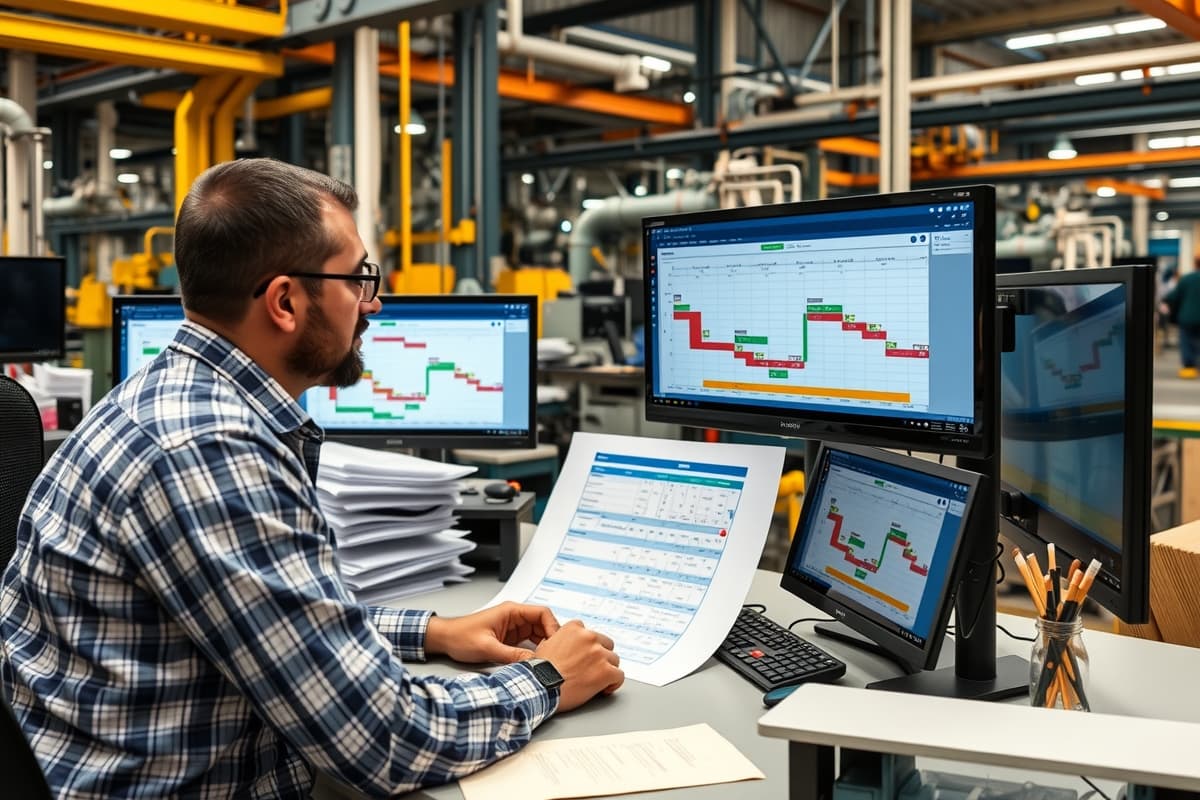
Mid-shift breakdown on PM-2
Scenario
PM-2 trips at 14:20. Forecasted 4-hour breakdown. Three confirmed SOs were scheduled to run on PM-2 in Shift B with delivery commit tomorrow morning.
Module Response
Planner triggers re-schedule. System checks PM-1 capacity, validates grade compatibility, recommends moving SO-2847 (1200mm kraft 100 GSM) to PM-1 at 16:00 with 8-minute grade-change. Two SOs auto-reslot to next available window. Customer service notified, no missed commits.
time
3 min
missed orders
0
overtime
+4 hrs PM-1
Case 02
Daily plan with grade-change minimization
Scenario
Tomorrow's MPS has 14 grade runs across 2 PMs covering 28 SOs. Manual sequencing produces 9 grade changes (~6 hours of penalty waste).
Module Response
Grade-change optimizer runs penalty matrix across all permutations. Recommended sequence: 5 grade changes, mostly WITHIN_FAMILY. Predicted waste 1.4t vs manual 3.8t. Predicted downtime 1h 12m vs 3h 50m. Planner approves with one override (customer priority).
changes
9 → 5
waste saved
2.4 t
time saved
2h 38m

Case 03
OEE dropped 7 pts. Find it.
Scenario
PM-1 OEE down from 81% to 74% over 3 days. Plant manager wants root cause before next ops review.
Module Response
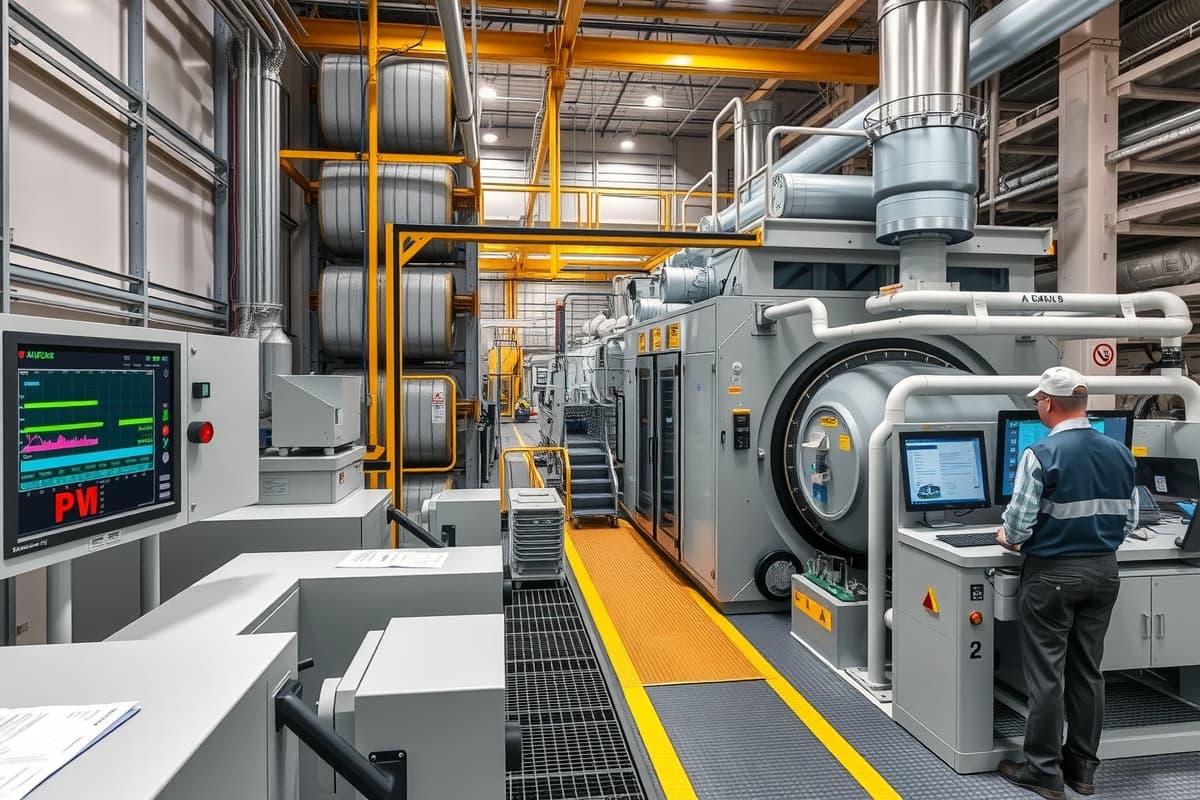
Loss waterfall: Availability -3.2 pts (unplanned breakdowns up), Performance -2.1 pts (speed drift on 80 GSM grade), Quality -1.7 pts (defect rate at the calendar). Drill into defect Pareto: edge crack on Reels 4823–4891. Cross-ref with maintenance: bearing replaced on calendar 6 days ago. Predictive alert was issued at install — operator missed acknowledgement.
time to RCA
11 min
root cause
calendar bearing
actions raised
3
Case 04
Integrated mill: stock-prep starves PM-3
Scenario
Integrated mill, 3 PMs, single pulping line. PM-3 about to start 120 GSM run, but pulp tower at 38% — below the 45% safety threshold for grade-change.
Module Response
CRP detects upstream constraint, recommends delaying PM-3 grade-change by 22 minutes or pulling SO-2891 (compatible grade) forward. Planner picks pull-forward. PM-3 stays running, pulp builds back to 52% by handover. No downtime, no broke spike.
downtime avoided
22 min
broke avoided
~1.8 t
planner clicks
2
Performance Comparison
Manual vs Production module.
Before/after numbers from a representative 200 TPD mill running 90 days post go-live.
Implementation
Live in 30 days.
Typical paper mill rollout. Longer for greenfield integrated mills, shorter for single-PM units.
Machine + BOM master
- PM and ancillary machines setup
- Active BOM and routing versions
- Operator and crew master
- Shift calendars + maintenance windows
Planning calibration
- MPS bucket configuration
- Lot-sizing rules per item
- Grade-change penalty matrix seeding
- CRP capacity profiles per machine
Shop floor rollout
- Mobile app rollout to crews
- Reel quality reading SOP
- Downtime reason library
- QC parameter master per grade
Go-live
- First live MPS run
- WO lifecycle activated
- OEE dashboards live
- Daily standup with planner
Continuous tuning
- Grade-change matrix self-refines
- OEE benchmark locked
- Optimization recommendations active
- What-if scenario library grows
Every Capability
Drill into any feature.
Click any capability to drill in.
Integrations
Works with everything else.
Every Production action flows into the other modules — no manual data re-entry, no reconciliation pain.
Production→Inventory
WO release → Material Issue
Stock ledger consumption posted in real time
Production→Inventory
WO complete → FG batch
Finished goods batch auto-created on QC pass
Production→Product Catalog
WO release → BOM check
Release blocked if no active BOM or routing version
Production→Finance
WO close → cost settlement
Variance posted to GL; overhead absorption calculated
Production→Sales
SO confirmed → MPS demand
Net-change demand added to MPS automatically
Production→HR
Labor entry → cost rollup
Employee rates pulled; overtime flagged for approval
Production→Maintenance
Downtime event → work request
Unplanned downtime auto-raises maintenance work request
Production→Deckle Optimizer
Schedule run → slit plan
Grade/width from schedule feeds deckle optimization
Ready to modernize your mill?
See Papyrus BPApp
in your mill.
Book a personalized demo. We'll walk through every module relevant to your operation — from Deckle optimization to GSTR-3B compliance.
FAQ
Production — common questions
Does it cover MPS, MRP, and CRP?+
Yes. Master Production Schedule (MPS) plans what to produce when. Material Requirements Planning (MRP) calculates pulp, chemicals, packaging needs. Capacity Requirements Planning (CRP) validates against machine and labour capacity.
How is OEE tracked?+
Availability × Performance × Quality calculated per shift, per machine, in real time. Downtime reasons captured at the machine via shop floor app or PLC integration. Root-cause analytics built in.
Can it handle multi-PM (multiple paper machines) on same campus?+
Yes. Each machine has its own schedule, OEE, and crew. Pulp allocation across PMs is calculated automatically.
Mobile shop floor app available?+
Yes. Operators log work order status, downtime, quality samples on mobile/tablet. Supervisors approve handovers on mobile.